The version of you that performs
Why being watched changes posture, expression, and even memory, and why the camera often receives a practiced substitute instead of the person underneath.
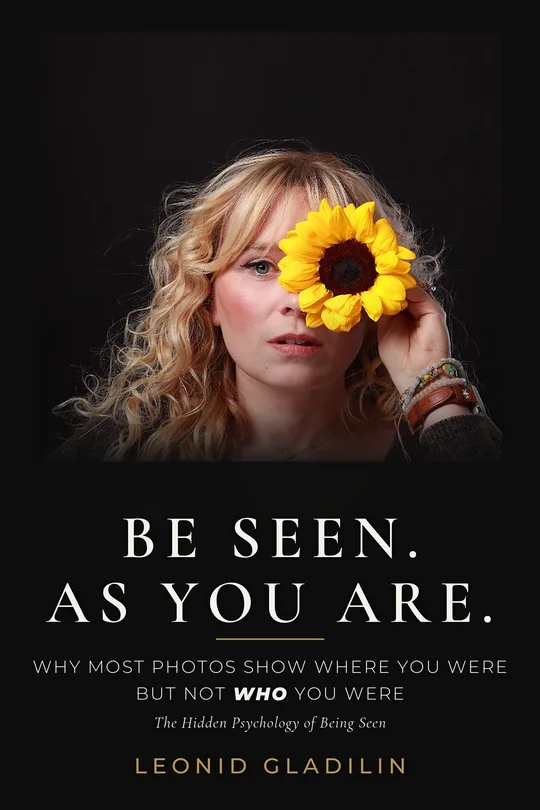
A book by Leonid Gladilin
Why most photos show where you were but not who you were
Most photographs prove that you were there. This book asks a harder question: did the person in the photograph feel like you? Through stories from behind the mirror at HQ Portraits, it explores performance, self-recognition, and the rare relief of no longer trying to look right.
The Amazon edition is available now. The free reader kit is available now.
The hidden psychology of being seen
Many people say they hate being photographed. Often, what they hate is the moment they become aware of being watched. The face changes. The shoulders arrange themselves. A familiar performance steps in before the shutter clicks.
Be Seen. As You Are. follows what happens when that performance loses its audience. At HQ Portraits, there is professional light, a mirror, and a wireless clicker, but no photographer in the room. People choose the instant for themselves. The result is not simply a different kind of portrait. It is a small experiment in attention, control, and recognition.
This is not a posing manual and it is not a promise that every insecurity disappears. It is a book about the distance between being visible and feeling known, told through the quiet, funny, and sometimes startling moments that happen when a person meets their own gaze without instruction.
A photograph can record your face. Recognition begins when you stop asking the face to prove anything.
Inside the book
Why being watched changes posture, expression, and even memory, and why the camera often receives a practiced substitute instead of the person underneath.
What becomes possible when you decide when the image is made, while light, structure, and care still hold the room around you.
How a technically imperfect photograph can feel more valuable than a polished one because it contains a look, gesture, or presence you recognize as your own.
Book activation
Register your copy with an email address and receive the complete Continue the Practice Kit as one printable PDF. It is designed to be useful in short sittings, without turning the book into homework.
Hidden chapter
Days 2 to 7
8 printable cards
Reusable journal
Made to be finished
The kit keeps the commitment deliberately small. Read one page. Notice one thing. Write a few honest lines. Return when the next prompt feels useful.
Name the second mirror, the imagined audience that can quietly direct how you look, move, and judge yourself even in private.
Days 2 through 7 each ask for a brief act of attention. No streaks, scores, or perfect answers are required.
Print the cards you want, reuse the journal pages, and leave the rest. The kit is a set of tools, not a test you can fail.
Questions
It is a narrative exploration of what changes when people can photograph themselves without a photographer watching. The book connects portrait-making with performance, control, self-consciousness, memory, and self-recognition.
No. The studio is the setting and source of the stories, but the questions belong to anyone who has ever felt unlike themselves in a photograph.
You receive one printable PDF containing the hidden chapter The Second Mirror, the complete days 2 through 7 practice, eight reflection cards, and a reusable reader journal.
No. The kit delivery email is transactional. Marketing permission is a separate optional choice, and the reader record keeps that choice explicit.
Be seen. As you are.